
Gilchrist County Criminal Court Cases
Gilchrist County is part of Florida's Eighth Judicial Circuit. The Circuit Court hears felony prosecutions and juvenile delinquency matters. Gilchrist County Court handles misdemeanors and criminal traffic. The Clerk of the Circuit Court and Comptroller maintains both sets of case files through the courthouse at 112 South Main Street in Trenton. Its criminal department overview identifies the separate felony and misdemeanor functions, while the main clerk number, 352-463-3170, serves all court departments.
The clerk file begins when a complaint, information, indictment, notice to appear, or other starting paper is filed. It then grows through motions, hearing notices, orders, plea papers, judgments, and sentence entries. A jail intake charge can differ from the charge the State Attorney files. For that reason, the filed information and the final disposition are more useful than a booking label when the goal is to understand a Gilchrist County court case.
Civitek Opens Gilchrist Case Records
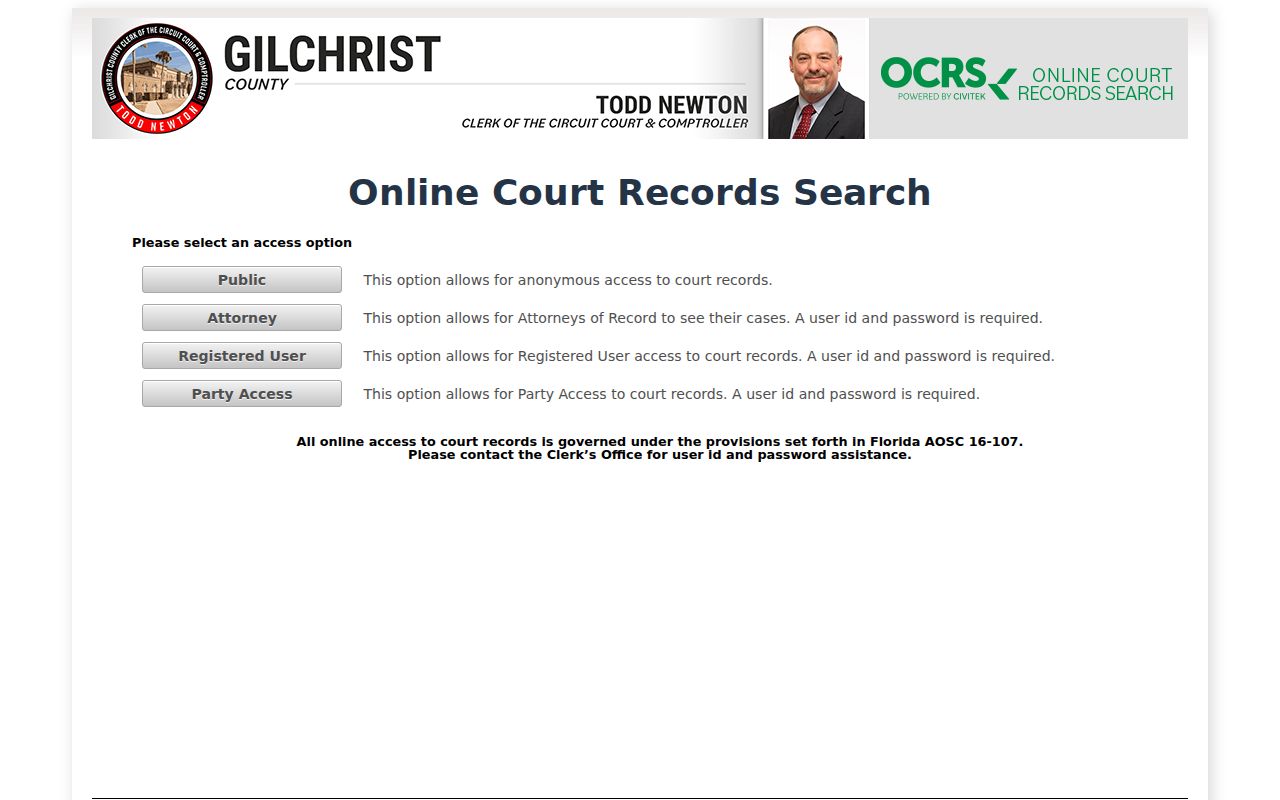
The official remote gateway for Gilchrist County criminal case records is the Civitek Florida Courts E-Filing Authority public records service. It offers Public, Attorney, Registered User, and Party Access entry points. An ordinary reader can choose Public, accept the disclaimer, and search without an account. Credentialed options are separate and do not imply that an anonymous user can see every image or confidential filing.
The official Gilchrist Civitek gateway is shown in the manifest capture below. The screen confirms that remote access begins with the county-specific public portal, not a statewide Florida trial-court index.
The gateway is a first pass. Missing images, older material, certified judgments, and restricted records still require direct clerk contact.
Searching Gilchrist County Case Records
Use the narrowest reliable facts available. A case number is best, but a full legal name, date of birth, filing range, and case type can separate similar names. Civitek does not label the name or case-type fields as required, and the anonymous search has no stated fee. Avoid entering a Social Security number unless its use is necessary and authorized.
- Open the Gilchrist Civitek gateway, select Public access, and accept its disclaimer.
- Enter a last name and first name or middle initial. Use a business name only when the named party is an organization.
- Narrow the search with date of birth, filing dates, or a criminal case type such as CF, MM, or CT.
- Open the matching docket. Compare the case number, court division, charge rows, filing dates, and event history.
- Call 352-463-3170, inspect at 112 South Main Street, or send a focused written request when an image, older file, or certified copy is needed.
| Field | Type | Required | Use |
|---|---|---|---|
| Last Name | Text | Unspecified | Person search |
| First Name/MI | Text | Unspecified | Narrows a person match |
| Business Name | Text | Unspecified | Alternative party search |
| Date Case Filed From/To | Date range | No | Limits results by filing date |
| Date of Birth | Date/text | No | Helps distinguish common names |
| Case Type | Multi-option | No | CF felony, MM misdemeanor, CT criminal traffic, and other listed divisions |
Gilchrist Felony and Misdemeanor Paths
Case type tells the reader which local court owns the matter. A CF file belongs to Circuit Criminal and points to a felony prosecution. An MM file belongs to County Criminal and marks a misdemeanor. CT covers criminal traffic. The same clerk serves these courts, but the legal track, charge degree, possible sentence, and department handling the file differ. Municipal ordinance codes can appear in the portal, yet Florida's unified court system does not create an active city criminal court in Trenton, Bell, or the Gilchrist portion of Fanning Springs.
The State Attorney's Gilchrist office prosecutes felony, misdemeanor, traffic, and juvenile matters. It may file an information with charges that differ from the arresting agency's intake list. The office also uses deferred prosecution, pretrial intervention, deflection, and therapeutic or diversionary court when its policy and the case facts allow. These paths may create docket entries and an outcome that cannot be understood from the first charge line alone.
Inside a Gilchrist County Case File
A Gilchrist County criminal court file is a charge-level record. Read the event chronology and each count. “Disposed” only says that case activity reached an endpoint; it does not state whether the result was dismissal, acquittal, withheld adjudication, or conviction. Document images may show the exact information, plea, judgment, and sentence behind a short docket label.
| Case Number and Court | Identifies the court division, year, sequence, and local file. |
|---|---|
| Charging Document | Shows the formal offenses filed by complaint, information, indictment, or notice. |
| Docket Entries | Lists filings, hearings, motions, orders, and other events by date. |
| Charge Rows | May show offense text, statute, degree, plea, adjudication, and outcome for each count. |
| Disposition and Judgment | Records dismissal, nolle prosequi, acquittal, withhold, or adjudication of guilt. |
| Sentence and Conditions | Can include custody, probation, fines, costs, restitution, and linked capias events. |
Read Gilchrist Charge Outcomes
One Gilchrist County case can contain several charges with different endings. The case header cannot replace the count rows. A dismissed count ended without a guilty result on that count. Nolle prosequi means the prosecutor formally chose not to continue it. An acquittal follows a not-guilty verdict. A withhold follows a plea or finding but withholds formal adjudication, and it is not an acquittal.
- Disposition
- The final result for a case or one charge.
- Nolle prosequi
- The State Attorney's formal decision not to proceed with a charge.
- Adjudication withheld
- A Florida result that withholds formal guilt after a plea or finding.
- Capias
- Court process directing that a person be taken into custody.
When the public index and a statewide FDLE history differ, compare the final Gilchrist County judgment with the arrest cycle. A reporting delay or an event without fingerprint support can leave the repository incomplete. Someone reviewing their own entry can use FDLE's free fingerprint-based Personal Review to challenge an error.
How a Criminal Case Moves
The court record starts after law enforcement or a prosecutor brings the matter into court. First appearance addresses custody and release. The State Attorney then chooses whether and what to file. Arraignment addresses the formal charge and plea. Discovery, motions, negotiation, or trial follow. A judgment and sentence close the trial-level path, though appeal or postconviction work can add later entries.
Case flow: Charges Filed › Arraignment › Pretrial › Plea or Trial › Disposition › Sentencing
This sequence explains why a new booking may not yet have a Gilchrist County case number. It also explains why a filed charge may not match the jail's first label. For the earlier custody event, use the county arrest lookup channels; for the court result, return to the clerk docket.
Missing Gilchrist Court Images
No online image does not mean no court record exists. Older papers, certified documents, confidentially screened items, and records not yet imaged can require clerk assistance. Call the clerk at 352-463-3170 or inspect the file at the Gilchrist County Courthouse. A written request should identify the case number, document title, and the exact item sought. Ask about the current copy or certification cost before ordering; the research found no local itemized fee schedule to quote.
The clerk says filed records are open for inspection during normal business hours unless a statute or court order makes them confidential. That promise concerns lawful public access, not universal remote display. A certified judgment comes from the clerk, not from a screenshot of Civitek or an FDLE name search.
Note: Call before visiting because the reviewed official pages did not publish clerk counter hours, parking rules, or courthouse phone restrictions.
Case Record Access and Restrictions
Florida Rule of General Practice and Judicial Administration 2.420 makes judicial records presumptively open but recognizes confidential categories. Juvenile delinquency information is restricted. The Gilchrist clerk does not provide juvenile details by telephone; an authorized child, parent or guardian, attorney, justice official, or specified agency must follow the in-person identification process. Protected victim details, medical data, Social Security numbers, full account numbers, sealed files, and other exempt material can also be hidden or redacted.
Florida Public Records Law applies to agency records, while court access follows the judicial rule. The clerk's public-inspection policy is the local source for filed court material. GCSO reports are held by the sheriff, not the county administrator or clerk. FDLE supplies a separate statewide history product rather than the pleading and document images in the Gilchrist County case file.
Fix Exposed Gilchrist Court Data
The Gilchrist clerk warns filers not to place Social Security numbers or complete bank or card account numbers in a public filing unless required. If that information appears in a publicly available court image, a person may ask the clerk to remove it. The request should state the case number, document title, and exact page. Mail, fax, electronic transmission, and in-person delivery are accepted, and the clerk charges no redaction fee for this process.
This remedy targets an exposed identifier in a public image. It does not erase the case, change the judgment, or substitute for court-ordered sealing or expunction. A person seeking broader relief must follow Florida eligibility rules and obtain the required court order.